
The assessment has come back and it says BAL 29. If you are building on the Mornington Peninsula or the Surf Coast, this is the number most sites land on, and it is the one that shapes the architecture most. Lower ratings barely touch the design. Higher ratings start removing materials from the palette. BAL 29 sits in the middle, where the right decisions at concept stage make the difference between a house that looks like it was designed for the site and one that looks like it was designed for the standard.
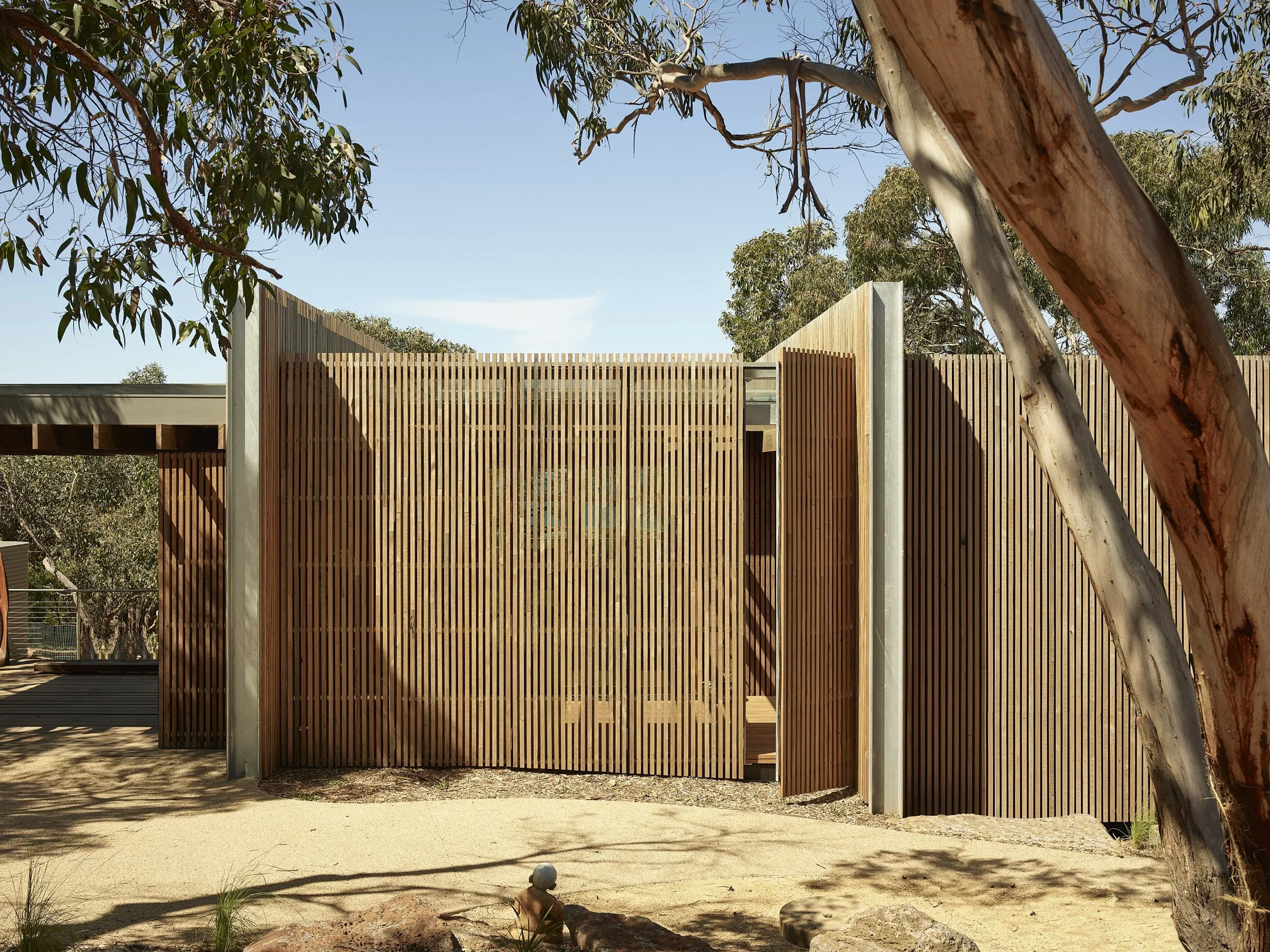
We have built to BAL 29. Our Anglesea Passive House sits on a BAL 29 site and carries passive house certification, which meant the bushfire envelope and the airtight envelope had to be resolved together. What follows is what we learned doing it.
What does a BAL rating of 29 actually mean?
A Bushfire Attack Level measures the radiant heat a building may face in a bushfire, in kilowatts per square metre. BAL 29 means the building is designed for exposure up to 29 kW/m2, with significant ember attack and burning debris, but without direct flame contact expected.
For scale, the sun at midday on a summer's day delivers about 1 kW/m2. The human pain threshold is about 2 kW/m2, at which point bare skin suffers a second-degree burn in roughly 40 seconds. Renew magazine's architect-authored guide to AS 3959 sets out those comparisons. BAL 29 is fourteen times the pain threshold. It is the level at which the house has to survive intense radiant heat and a sustained ember storm.
AS 3959:2018 defines six levels. BAL-LOW carries no construction requirements. BAL 12.5 covers exposure up to 12.5 kW/m2, mostly from embers. BAL 19 covers 12.5 to 19. BAL 29 covers 19 to 29. BAL 40 covers 29 to 40 with some flame contact possible. BAL-FZ is direct flame exposure above 40.
Why do so many Peninsula and Surf Coast sites come back at BAL 29?
Because of what surrounds them. Mornington Peninsula Shire's 2023 strategic bushfire assessment states that all land in the Shire sits within a Bushfire Prone Area, except urban land not at the immediate hazard interface on Port Phillip Bay and the Western Port settlements. The southern Peninsula from Rye to Sorrento is inside the BPA. Parts of Portsea are excluded.
The rating is set by three things: distance to classified vegetation, the type of that vegetation, and the slope under it. Mornington Peninsula National Park runs as a linear corridor of hazard along the back beach. Ti-tree and moonah scrub on residential blocks counts as vegetation. And the Shire's assessment notes, citing the CFA, that for every 10 degrees of slope a fire doubles its speed, which is why a sloping block facing the back beach can carry a higher rating than a flat one a street away.
The Surf Coast tells the same story with different trees. The Anglesea Passive House sits in coastal heathland with a 200 square metre footprint chosen partly to retain as much vegetation as possible while holding to BAL 29.
One rule that catches Melbourne clients: in Victoria, any site inside a Bushfire Prone Area must be built to a minimum of BAL 12.5 even if the assessment returns BAL-LOW. That is Section 192A of the Building Act 1993. Boroondara, Stonnington and Bayside have no designated Bushfire Prone Areas at all, so a client moving from Hawthorn or Brighton to the coast is meeting this for the first time.
What changes in the construction at BAL 29?
The practical difference between BAL 19 and BAL 29 is cladding. At BAL 12.5 and 19, only wall cladding within 40 centimetres of a horizontal surface needs to be brick, fibre cement, metal or a bushfire-resisting timber. At BAL 29, that requirement applies to all external cladding.
Foundation posts must be a bushfire-resisting timber species, steel or brick. A slab on ground carries no subfloor requirement. Every gap, joint and weephole is sealed with metal mesh of aperture under 2 millimetres, which is the ember rule at every level. Glazing is toughened or screened. Decks need compliant boards or non-combustible support. Roofs are sealed at every junction.
What BAL 29 does not do is remove timber from the palette. That happens at BAL 40, where external timber is prohibited except for balustrades with a gap to the building. At 29, the question is which timbers, and that brings us to the one everyone asks about.
Is Merbau BAL 29?
It is the most common timber question we get, and the honest answer is that it depends on the application. AS 3959 sets out a list of bushfire-resisting timber species tested for use at BAL 29, and whether a given species qualifies for cladding, decking or structure is set by that list and its testing, which changes between editions of the standard.
At Anglesea, the vertical screening is reclaimed turpentine and ironbark. Both are dense Australian hardwoods and both were specified to satisfy the rating. If you have a species in mind for a specific use, check it against the current AS 3959 list for that use, or ask us and we will tell you what we would specify and why.
Can you build a passive house on a BAL 29 site?
Yes. We have. But the two standards pull against each other in one place, and that place is the envelope.
A certified passive house must achieve airtightness of 0.6 air changes per hour at 50 pascals. The Australian Government's YourHome guide puts the average new Australian home at 15.4. That is 25 times tighter than a standard build. BAL 29 demands that every gap be sealed against embers. On paper the two agree. In practice, bushfire mesh at vents and ember-proofing at every penetration has to be detailed so it does not become a thermal bridge or an air leak. The glazing has to satisfy the BAL requirement and passive house performance at once, which means the window specification is doing two jobs.
At Anglesea we resolved it through the compact footprint, the timber screening, and a builder in Aphi Projects willing to detail every junction twice. The result is a house that meets both standards without either one being visible in the finished architecture.
What is a good BAL rating?
Lower is easier. But a good BAL rating is the one that was established before the design started, not after.
Renew's guide makes the point that the difference between BAL 29 and BAL 40 can be a few metres of siting. Move the building away from the boundary that faces the hazard and the rating can drop a level. That is a decision made at concept, on the site, before anything is drawn. Made at tender, it is a redesign.
The Shire's assessment also notes that the most severe bushfire impact on the southern Peninsula is focused within 50 metres of the national parks. Beyond that strip, the landscape risk falls. Knowing where your block sits relative to that line is the first thing we look at, on the Peninsula and on the Surf Coast.
Talk to us before the brief is fixed
If your site has come back at BAL 29, or you are looking at a block on the Peninsula or the Surf Coast and want to know what it will mean for the house before you commit, that is a conversation we have often. Arrange a design consultation and we will look at the site together.
FAQ block
Does a BAL 29 rating mean my house will survive a bushfire?
No. AS 3959 construction is designed to give occupants a measure of protection while a fire front passes and to reduce the chance of ignition from embers and radiant heat. It is not a guarantee of survival, and the standard says so. What it does is make survival far more likely, particularly against ember attack, which is the most common cause of house loss.
Can I still use timber cladding at BAL 29?
Yes, from the bushfire-resisting species listed in AS 3959. External timber is prohibited at BAL 40, not at 29. At BAL 29 the whole facade must be compliant rather than just the lowest 40 centimetres, so species selection matters more than at BAL 19. At Anglesea we used reclaimed turpentine and ironbark for the vertical screening.
Who carries out the BAL assessment?
A suitably qualified bushfire consultant. Planning Victoria points to the Fire Protection Association Australia as the body that trains and accredits assessors. We recommend commissioning the assessment before the design brief is fixed, because the result can change the siting, the footprint and the palette.
Does my BAL rating change if a neighbour clears their block?
It can, in either direction. The rating depends on classified vegetation within the assessment distance, which includes land you do not own. If the surrounds change materially, a reassessment is worth doing. The reverse is also true: a neighbour's revegetation can push a rating up.
Is the whole Mornington Peninsula inside a Bushfire Prone Area?
Almost. Mornington Peninsula Shire's 2023 strategic bushfire assessment states that all land in the Shire is within a Bushfire Prone Area except urban land not at the immediate hazard interface on Port Phillip Bay and the Western Port settlements. Rye to Sorrento is in. Parts of Portsea are out. The bay-side urban strip between Rosebud and Rye, and the urban parts of Mornington and Mount Eliza, are generally out. The Shire report itself notes that some of this mapping may warrant review.